
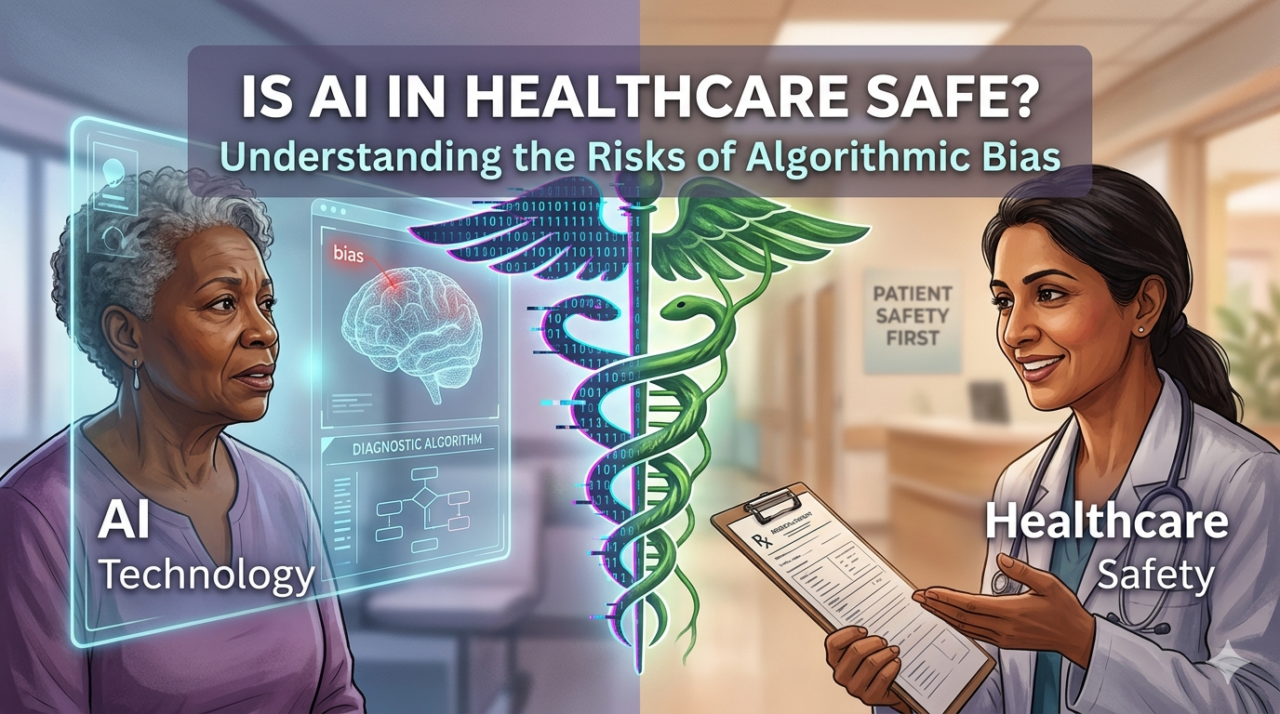
Is AI in Healthcare Safe? Understanding the Risks of Algorithmic Bias
AI has become a permanent fixture in modern medicine. While its potential to save lives is immense, we must confront the sobering risks that accompany its rapid adoption. We are currently in a high-stakes race where innovation is outpacing regulation, and the safety nets we rely on are fraying. Unlike a software glitch in a smartphone, a ‘hallucination’ in a diagnostic algorithm isn’t just a nuisance—it’s a life-altering event. When the ‘digital doctor’ makes a mistake, the consequences are measured in human lives, leaving us to wonder: are we traded clinical intuition for algorithmic efficiency too soon?
1. The Bias Trap: Automating Inequality
An AI is only as effective as the data used to train it. Because historical medical research has frequently underrepresented marginalized groups, algorithms often inherit these systemic gaps. For instance, skin cancer detection tools trained primarily on lighter skin tones are significantly less accurate for patients of color. By automating these flawed systems without intervention, we don’t just reflect inequality—we amplify it at scale.
2. How Can We Trust What We Don’t Understand? The AI Black Box Dilemma
One of the most unsettling aspects of advanced AI is its lack of transparency; even its creators often cannot explain how a model reaches a specific conclusion. In a field built on “evidence-based medicine,” a recommendation without a “why” is inherently dangerous. Whether it’s a high-risk surgery or a specific drug dosage, clinicians must understand the underlying logic to validate a path forward. Without transparency, we risk placing blind faith in a machine that cannot explain its own errors.
3. Clinical “Hallucinations” and Errors
AI can be confidently wrong. Through a phenomenon known as “hallucination,” a model may fabricate medical facts or misinterpret complex symptoms. Unlike a human provider who can admit uncertainty, an AI might offer a definitive—but incorrect—diagnosis. A single software glitch or corrupted dataset could trigger a “mass medical error,” impacting thousands of patients before the flaw is even identified.
4. The Erosion of Human Judgment
As clinicians grow accustomed to AI “co-pilots,” there is a rising risk of automation bias—the tendency to stop questioning a machine’s output. If doctors stop double-checking algorithms because they are “usually right,” critical thinking skills may begin to atrophy. Medicine remains an art as much as a science; it requires the empathy and nuanced intuition that a line of code simply cannot replicate.
5. Privacy in the Age of Big Data
AI’s hunger for vast amounts of data creates a massive target for cyberattacks. Patient records are highly sensitive and hold significant value on the black market, making every new AI model a potential point of failure for a data breach. Furthermore, “de-identified” data is rarely 100% secure; sophisticated AI can often re-identify individuals from supposedly anonymous datasets, compromising patient confidentiality permanently.
6. The Dangers of HIPAA in an AI World
In the AI-driven landscape of 2026, the primary danger to HIPAA compliance is the “data hunger” of algorithms, which often conflicts with the fundamental principle of data minimization. Advanced AI models possess the terrifying ability to re-identify patients by cross-referencing supposedly anonymous medical records with public datasets, rendering traditional “de-identification” methods obsolete. Furthermore, the rise of “Shadow AI”—where clinicians use unauthorized consumer chatbots to summarize notes—creates invisible leaks of Protected Health Information (PHI) into unregulated servers. With the HHS Office for Civil Rights (OCR) now enforcing mandatory AI impact assessments as of February 2026, a single unvetted software integration can lead to catastrophic data breaches, multi-million dollar penalties, and a total loss of patient trust.